
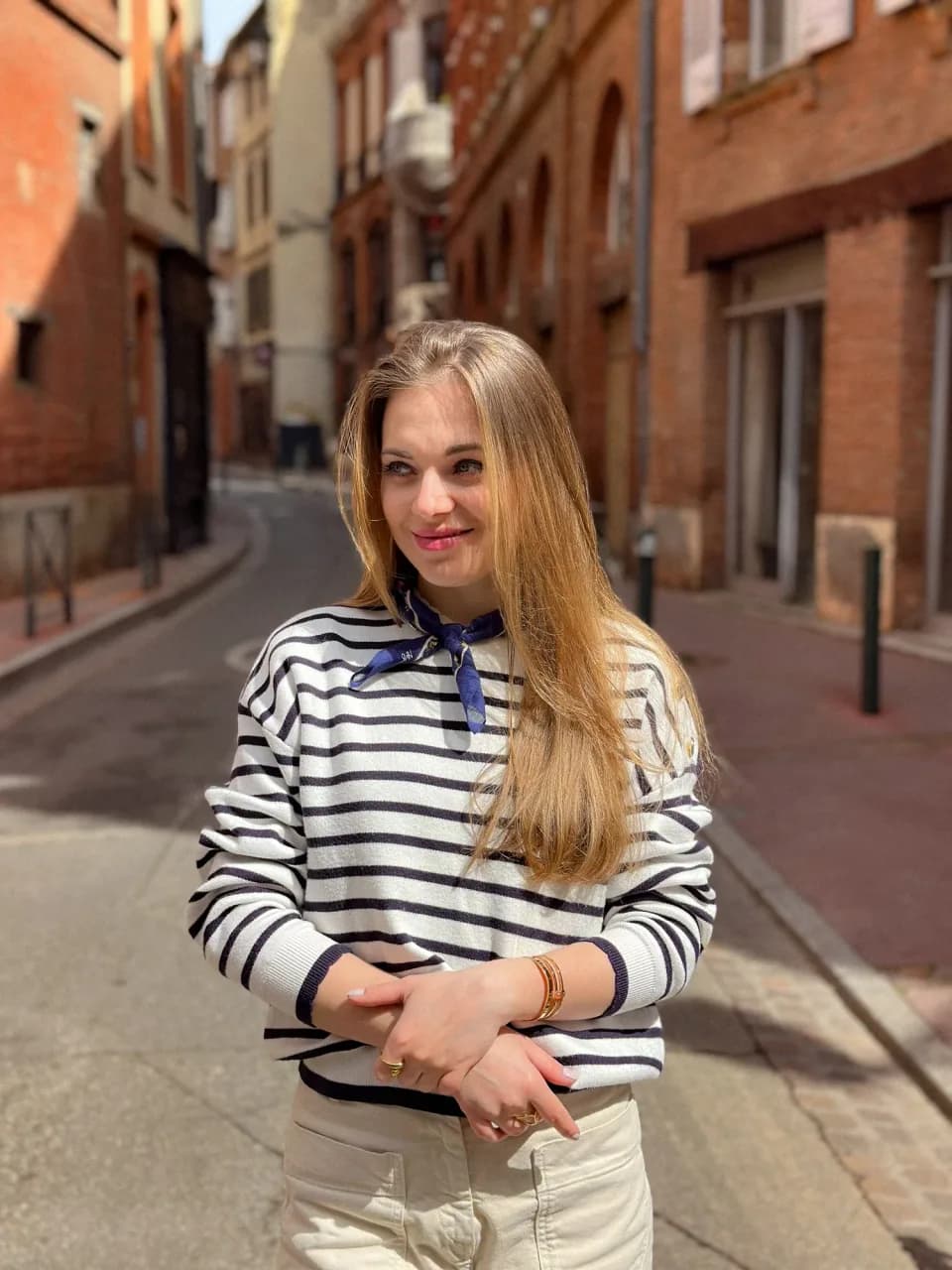
Who I am
Before I taught French, I learned it.
I’m Angelina Lukash. I teach French as a foreign language, in Toulouse and online.
I have been teaching languages for ten years, but my own story with French started long before my first lesson. I learned it as a foreign language, and I know both the stretches where you make fast progress and the ones where you feel stuck. Then I came to live in France, studied here, taught here and sat the DALF C2.
That experience shapes a great deal of how I work with my students today. I know the language from the side of the person who teaches it, and also from the side of the person who had to learn it.

The book
Chapter 01
It all started with a bookIt all started with a book
I grew up in Rostov-on-Don, in Russia. My first foreign language was English, which I started learning at six or seven.
French came a little later.
I was fourteen when I read Victor Hugo’s Notre-Dame de Paris. That book made me want to discover French literature, then French history, French culture, and finally the language itself.
Throughout my English philology degree, French stayed my second foreign language. I gave it less time than English, but the idea of one day living in France was already there.

Notre-Dame de Paris, by Victor Hugo
2016
Chapter 02
I wasn’t planning on becoming a teacher yetI wasn’t planning on becoming a teacher yet
I studied English philology, which means studying a language through its grammar, its texts and its literature. At the end of those years, the director of a language school in Rostov noticed me during my exams and offered me my first job.
I started teaching English to children, students and adults. Then, from 2016, I gave my first French lessons too.
Those first years are when I really learned my craft. I worked alongside other teachers, took part in seminars, and started building my lessons around the communicative approach.
It is also when I took the Cambridge ICELT course.
ICELTIn-service Certificate in English Language TeachingPress and hold to open
ICELT, in a few words
In-service Certificate in English Language Teaching
A course for English teachers who are already working.
During the course, I planned and taught lessons that were observed by my tutors and by the other teachers in the group. Every session was followed by detailed feedback.
That is where I learned a great deal about building a lesson: setting an objective, sequencing the activities, anticipating the difficulties, and thinking about what genuinely helps a student move forward.
That way of preparing a session is still with me today, even though the language I teach has changed.
2019
Chapter 03
In 2019 I arrived in ToulouseIn 2019 I arrived in Toulouse

Toulouse, 2019
Coming to France was a plan I had carried since I was a teenager.
In 2019 I finally left Rostov for Toulouse, to continue my studies and improve my French. The idea was already to build my life here.
I joined the fourth year of the programme run by the DEFLE at the Université Toulouse Jean Jaurès.
I spent two years there, with a final year built largely around the teaching of French as a foreign language.
That is also the period when my French improved enormously.
2020
Chapter 04
Part of my French was built during CovidPart of my French was built during Covid
My first years in Toulouse coincided with the pandemic.
For part of that time, university classes were suspended or held remotely. So I worked a great deal on my own: reading, listening, going back over what I had learned, and looking things up for myself.
That period reminded me of something I often see in my students today: living in France helps enormously, but exposure to the language is not always enough on its own.
Curiosity, the habits you build, and the work you do between lessons matter a great deal too.
I know because I lived it myself.
?
I have also known the feeling of not making progressI have also known the feeling of not making progress
When I was learning French in Russia, I had several teachers and I worked regularly. And yet, for a while, it felt as though my level had stopped moving.
That experience still shapes the way I prepare my lessons.
I want the student to know what we are working on, why we are working on it, and what they should gradually be able to do on their own.
For me, a good lesson is a structured lesson in which the student has plenty of room to speak, to practise and to reuse what they learn.
DUEF
Chapter 05
DUEF: studying French in FranceDUEF: studying French in France
I studied at the DEFLE of the Université Toulouse Jean Jaurès, the department of French as a foreign language.
Those years let me both refine my own French and go deeper into how the language is taught.
DUEF
Diplôme d’Université d’Études Françaises
Among other things, I worked there on building a syllabus, designing lessons, and the different skills a learner draws on when picking up a foreign language.
It was also a particular moment for me: I was still learning French while building the tools that would let me teach it better.
2021
Chapter 06
From 2021 to 2023, a master’s in Slavic studiesFrom 2021 to 2023, a master’s in Slavic studies
From 2021 to 2023 I took a master’s degree in Slavic studies at the same university.
When you study your own language, your own culture and the history of your country from France, you see all three differently. I loved those years.
Alongside my studies, I was teaching English in two primary schools in Toulouse. It was a rich experience: it is where I discovered how the French school system works from the inside.
That degree did much to decide what came next. At the end of my studies, my professors offered me a position in the Russian department.
My professors became my colleagues.
2023
Chapter 07
Then I moved to the other side of the universityThen I moved to the other side of the university
In 2023 I started teaching at the Université Toulouse Jean Jaurès as a course lecturer.
From 2024 I worked there as a Russian lector with undergraduate students, teaching language, grammar, conversation and methodology.
Russian is my mother tongue, English my first foreign language, and French the one I teach in today.
That experience let me teach larger groups, grow more confident speaking, and keep thinking about how a foreign language is actually learned.
It also helped me pin down what I wanted to do next: devote myself to French as a foreign language.

2025
Chapter 08
In 2025 I sat the DALF C2In 2025 I sat the DALF C2
This time I was the candidate.
I sat it in December 2025, and preparing for it was real work on my own French. I read again, listened again, wrote again, and I went back to being the student: the one who doubts, who moves in steps, and for whom a week can feel like it gave nothing.
It was during that preparation that I discovered Anki, the flashcard app that shows you a word again just before you forget it. I still use it, I recommend it to all my students, and I have written an article on how I use it.
The exam taught me what I could not have guessed from a distance: how to arrange what you know so that it holds on the day, what each paper is really asking for, and how to organise your own work between two lessons. That is what I bring to the students I take towards the DELF or the DALF.
There is a crumpled draft lying around here… click to smooth it out
Today
Chapter 09
Today I work with adults from all over the worldToday I work with adults from all over the world
My students are Indian, Turkish, German, Spanish, Argentinian, Mexican, American, Russian, and of many other nationalities.
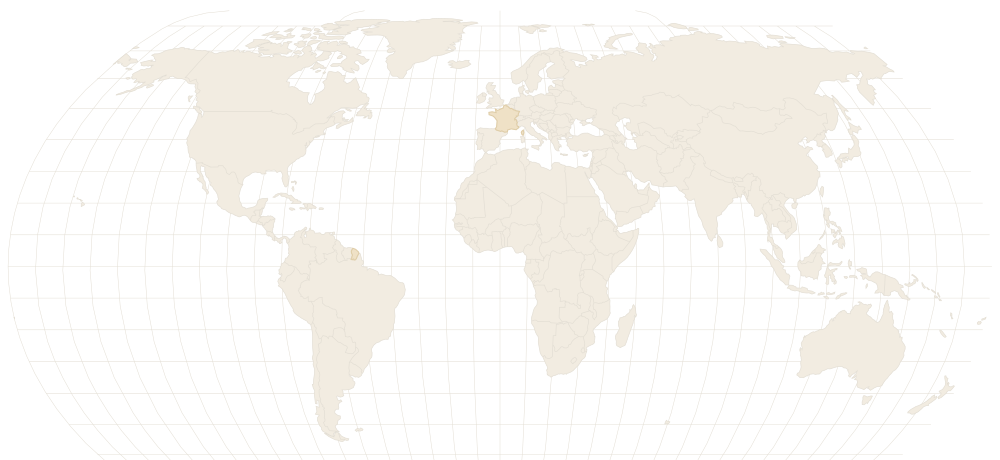
Some simply want to feel more at ease in their life in France.
Others are preparing a DELF or a DALF, a naturalisation interview, an administrative procedure, an important appointment, or one precise work situation.
I also work with companies who want to support their international staff as they learn French.
The goals are very different. That is exactly what I love about this job.
I particularly enjoy the courses where we can set a clear goal together and build the path towards it step by step.
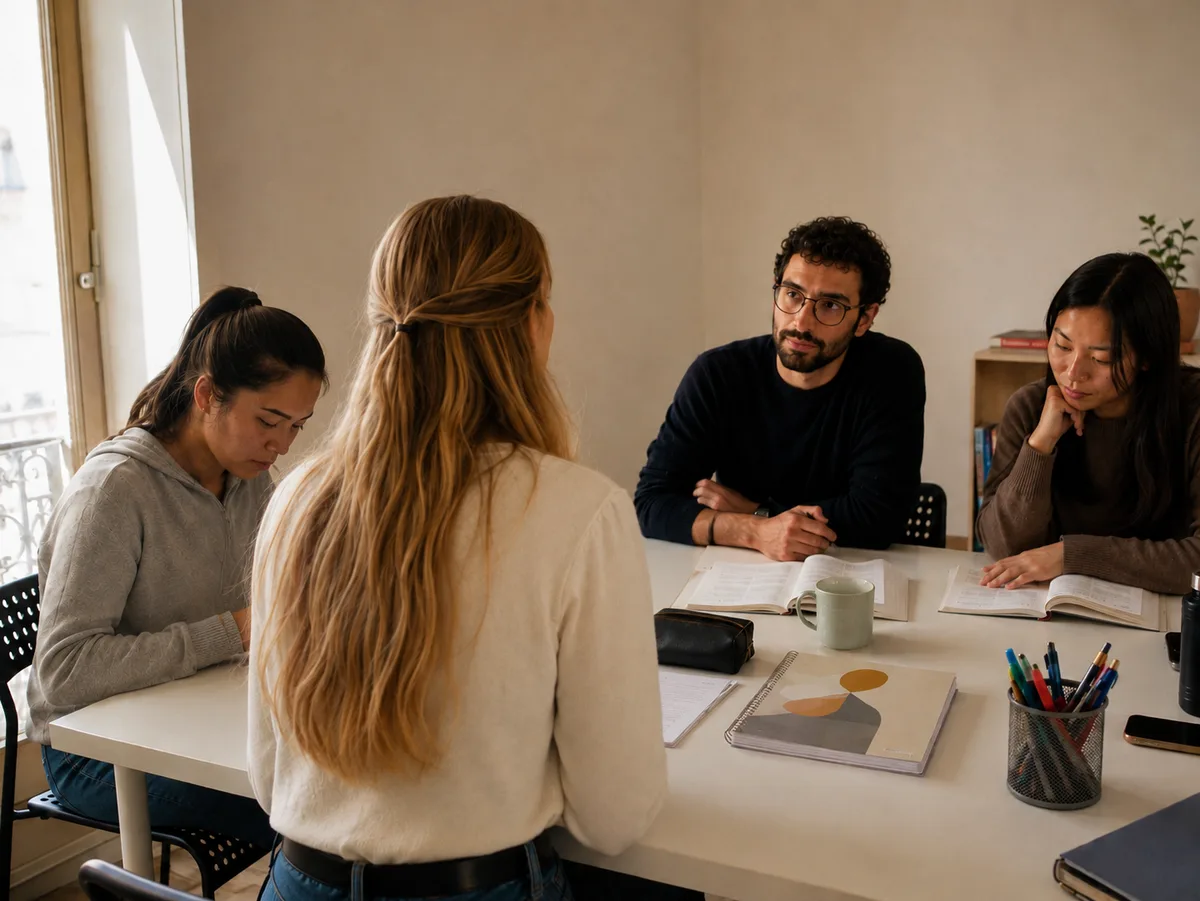
In class, in Toulouse and online
In class
What my own path changes in my lessons
« »
I know what learning French from the outside means
I was not born a French speaker. I had to learn the grammar, the vocabulary, the pronunciation, and also the small things that are not always in the textbooks.
It helps me understand some of the difficulties my students meet when they start living in French.
¶
I care a great deal about structure
My years of training and teaching taught me to build my lessons around a precise objective and a clear progression.
I want the student to see where we are going, and to notice what they can do today that they could not do a few weeks ago.
…
And I take the time
The word that comes up most often in my students’ feedback is probably “patience”.
I would add listening and structure.
Everyone moves at their own pace. My job is to find, with each person, the rhythm and the way of working that actually get them further.
And when I’m not preparing a lesson?
I have stayed very attached to what made me want to learn French in the first place: French literature and French history.
I read a lot, classic literature as much as books on language teaching. I love French music, French cooking, and discovering new places.
§
Toulouse has become my city. I came here to study in 2019 and I never did leave.
And since I am above all still a language learner myself, I would love to find the time to get properly back to Italian.
Click to stamp a flag
Three choices that come from this path
01
Speaking from the very first lesson
Creating situations early on where French becomes a language the student actually uses.
02
Building the lessons around the student
Starting from their level, their daily life, and what they want to be able to do in French.
03
Working on what surrounds the words too
The registers, the habits, the unsaid, and the codes that make exchanges in France easier to read.
Shall we start by getting to know each other?
For twenty minutes, we talk about your French, about what you would like to do more easily, and about how I can help you get there.
The call is free, with no commitment.